
AI models and Thinking mode
Tresor offers several AI models with different strengths. Choose between Instant and Thinking mode, compare models, and switch at any time — all running inside secure enclaves.
AI models and Thinking mode
In a nutshell: Tresor offers several AI models. Use Instant mode for fast, direct answers or Thinking mode for deep reasoning. You can switch models at any time — even mid-conversation.
Available models
All models run inside confidential computing environments. Your privacy is the same regardless of which model you choose.
Model | Strengths |
|---|---|
Kimi K2.5 (Recommended) | Versatile, strong reasoning, vision capable |
GPT-OSS 120B | Large, powerful general-purpose model |
DeepSeek v3.2 | Fast, efficient, great for drafting |
Llama 3.3 70B | Open-source, strong at following instructions |
Mistral 24B | Fast and uncensored |
GLM 5 | Large context window, multilingual |
💡 Tip: If you're not sure which model to use, start with Kimi K2.5 — it handles most tasks well and supports both images and deep reasoning.
Instant vs. Thinking mode
Models that support reasoning have two modes:
Instant mode
Best for: Quick questions, drafting, summarizing, translating, everyday tasks.
How it works: The model responds directly and quickly.
Example: "Translate this email to French" or "Summarize this paragraph."
Thinking mode
Best for: Complex analysis, multi-step problems, strategic planning, legal reasoning, math.
How it works: The model reasons step by step before answering. You'll see a "Thinking…" indicator.
Example: "Analyze the tax implications of restructuring our subsidiary" or "Find the logical flaw in this argument."
Selecting and switching models
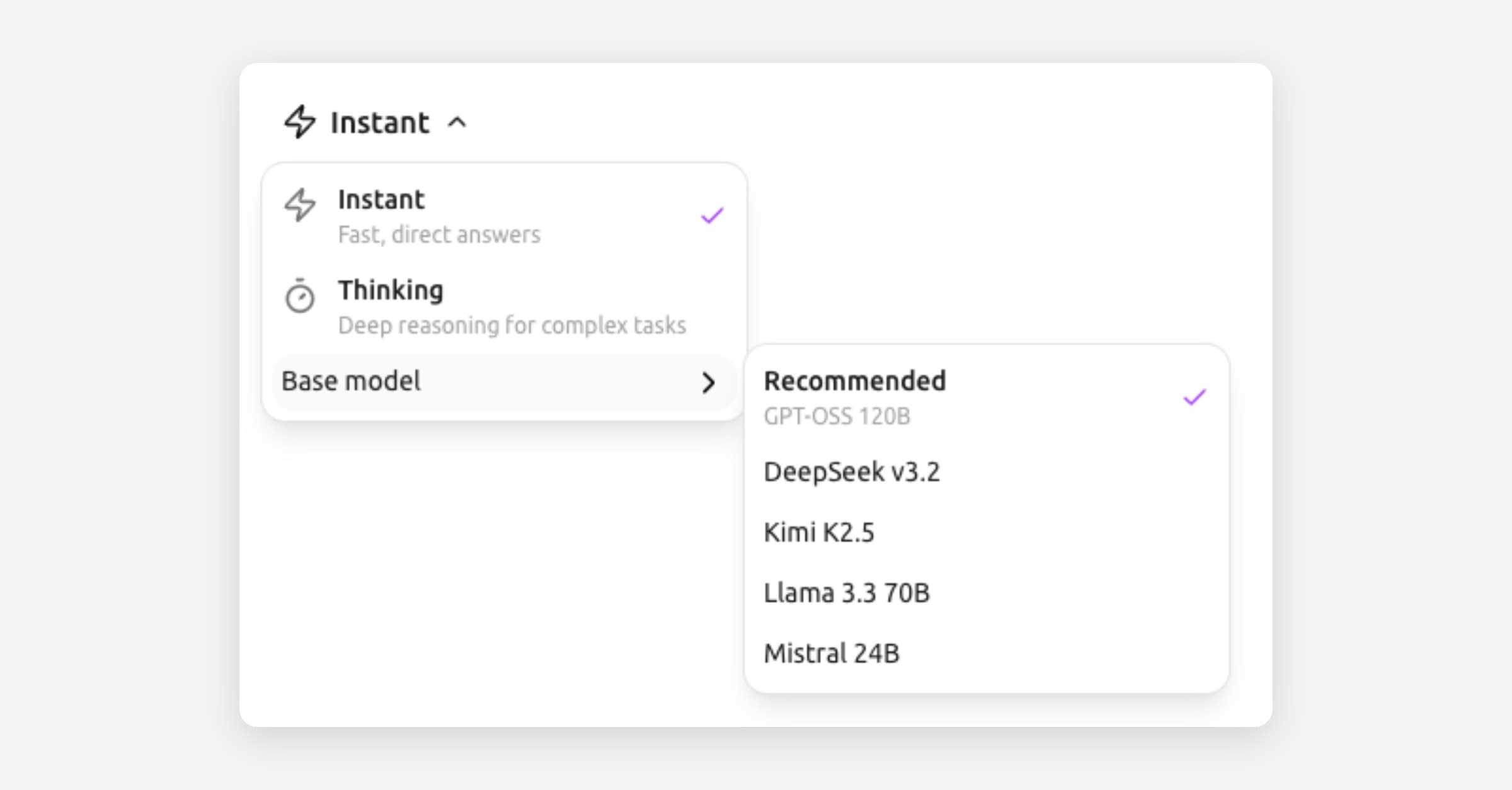
Look at the top navigation bar — it shows the name of the currently active model.
Click it to open the model selector dropdown.
Choose your preferred model.
If the model supports it, toggle between Instant and Thinking mode.
[Screenshot: The model selector dropdown in the top navigation showing available models and the Instant/Thinking mode toggle]
Switching mid-conversation
You can switch models at any point during a conversation. This is useful when:
You started with a fast model for quick drafts and now need deeper reasoning.
You want to compare how different models answer the same question.
A specific model is better for a follow-up task (e.g., switching to Kimi K2.5 for image analysis).
The AI keeps the full conversation history when you switch — it won't lose context.
Note: Switching doesn't reprocess old messages. Only your next message and the AI's response will use the new model. Your last-used model is remembered for new conversations.
Choosing the right model for the task
Task | Recommended model | Mode |
|---|---|---|
Quick Q&A, drafting, emails | DeepSeek v3.2 or Kimi K2.5 | Instant |
Complex reasoning, analysis | GPT-OSS 120B or Kimi K2.5 | Thinking |
Analyzing images or PDFs with visuals | Kimi K2.5 | Either |
Following detailed instructions | Llama 3.3 70B | Instant |
Unfiltered / uncensored responses | Mistral 24B | Instant |
Multilingual tasks | GLM 5 or Kimi K2.5 | Either |
Good to know
All models are equally private. Every model runs inside a verified secure enclave. The providers (OpenAI, Meta, etc.) do not receive your messages directly.
Model availability can occasionally change. If a model is temporarily unavailable, simply switch to another.
Thinking mode takes longer but produces more thorough answers. Use Instant when you need speed.
You don't need to pick the "right" model to get started. Try a few and see what suits your work.
Related articles
Your first conversation — Send your first private message.
Conversations — Create, organize, and manage your chats.
Verifying your conversation's privacy — See the proof for yourself.